


With summer officially over (goodbye sunlight, my old friend), and sweater weather fast approaching (we hope), the fall season can be one of the busiest and most consequential stretches of the work year, especially for nonprofit organizations. For most nonprofits, the last three months of the year aren’t just busy — they’re the season the rest of the year has been building toward, and what many rely on as one of their largest fundraising efforts. According to Blackbaud Institute’s 2025 Trends in Giving report, more than a third (36.1%) of annual nonprofit revenue comes in during the fourth quarter alone. In fact, the globally recognized day of giving, Giving Tuesday, kicked things off in a single, remarkable day: $4 billion raised across the U.S. in 2025, from 38.1 million people who decided that day was the day they’d give.
Add in the pull of tax-deductible year-end giving and the general spirit of generosity that tends to show up alongside the holidays, and it’s easy to see why fall and year-end campaigns carry so much weight for nonprofits. This is the window where a well-told story and a clear ask can do more for an organization’s budget than almost anything else all year.
If your organization hasn’t started planning your Q4, fall, or year-end campaign yet, now is the time. By Thanksgiving, the moment has passed and the season is barreling on without you.
But before a single graphic gets designed or a single email gets scheduled, there is one foundational question worth answering first: “Why should our supporters support our organization?”
You can’t out-design a confusing mission
It’s tempting to think a strong fall campaign is about the right graphics, the right subject line, the right posting schedule. Those things matter — but they’re the frame, not the foundation. The foundation is much simpler, and much harder. It must answer this question: can you tell a stranger, in one clear sentence, why your organization deserves their hard-earned dollars right now?
If the answer takes a paragraph, a mission statement, and a follow-up meeting to explain, no amount of good design is going to save the campaign built on top of it. Clear messaging, thoughtful visuals, a strong call to action, and real transparency about where the money goes is the actual formula. Skip the first one, and the rest is just decoration.
3 diagnostic questions to consider before you start
Sit down with your team before the campaign takes any real shape and answer these questions honestly:
Can a board member explain your mission in one sentence, without using the word “impact”? If ten board members would give you ten different answers, donors are getting ten different impressions of who you are.
Does your ask connect to something a donor can picture? “Help us reach our $50,000 goal” is a number. “Help us keep the lights on in our church for weekly worship and youth group gatherings throughout the year” is a moment someone can see.
If you removed your logo, would the message still sound distinctly you — or could it belong to any nonprofit sending a fall appeal? This is the fastest gut-check for whether your voice has actually differentiated itself, or just blended into every other appeal in someone’s inbox.
Build the message with a focused team
Once you’ve done this diagnostic work, resist the urge to open the messaging up to a large committee for feedback. It’s a natural instinct — more input feels like due diligence — but too many voices, especially non-expert ones, tend to dilute a clear message rather than sharpen it. The stronger path forward is a small, focused team: a communications committee, or a marketing and branding consulting firm who can protect the clarity of the message while still incorporating the organization’s institutional knowledge.
One message, many touchpoints
The other place campaigns quietly underperform is channel strategy. Relying on a single tactic — just a social media push, or just a mailed letter — asks one format to do all the work.
The organizations that see the strongest results treat the campaign as a layered experience: a social media presence that builds anticipation, a written letter that makes the ask personal, an email sequence that reinforces it, and something tactile that adds warmth like a postcard reminder with a photo of the people helped by the organization, or a handwritten thank-you note once the gift comes in. Each piece reinforces the same core message from a different angle, and each touchpoint builds trust with your donors.
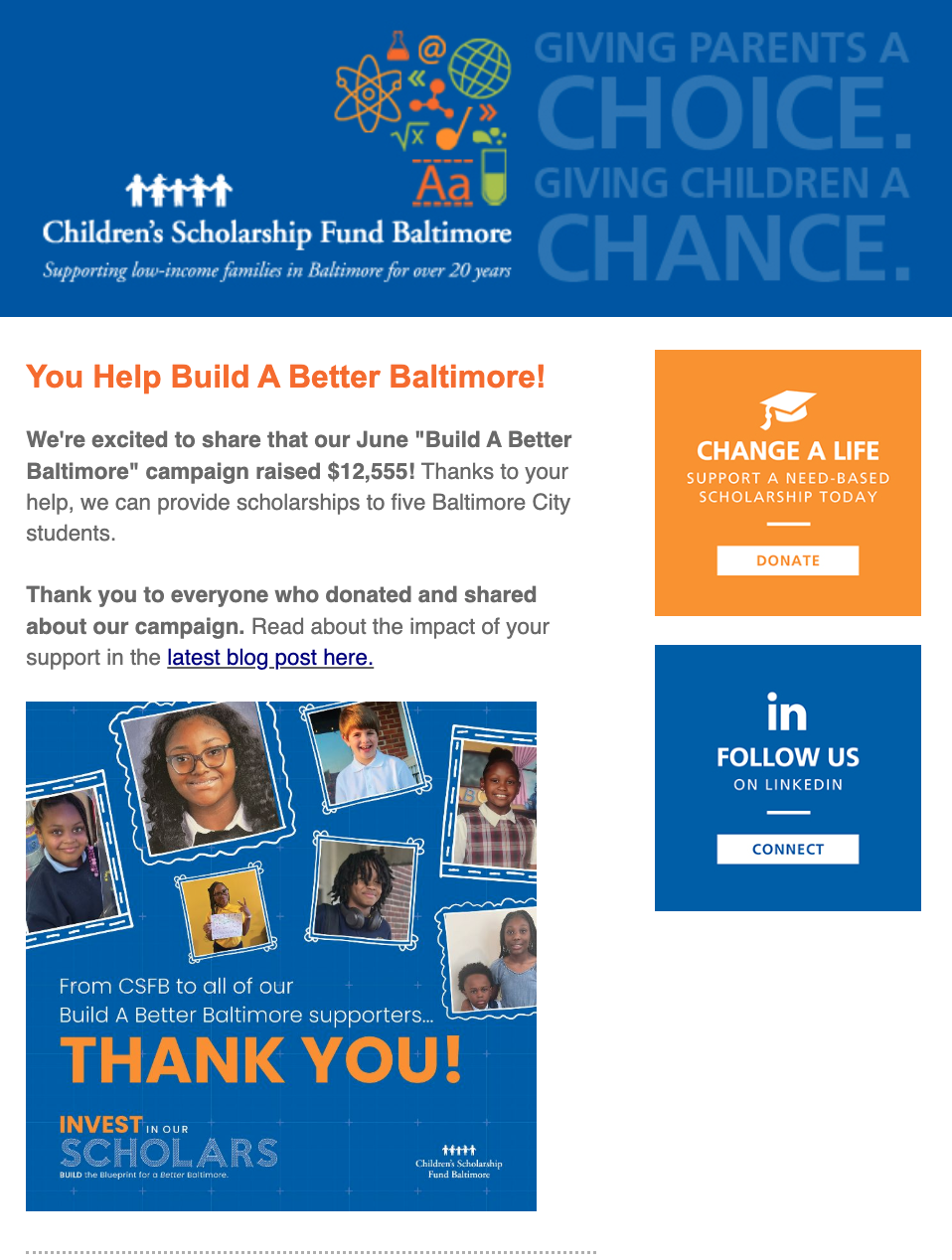
We’ve seen this success play out firsthand with insight180 clients like Children’s Scholarship Fund Baltimore, whose year-end campaigns have grown stronger since adopting this kind of whole-strategy approach — one clear message, delivered consistently across every channel a donor might encounter.
Why the whole board has to be on board after launch
Getting a nonprofit’s board aligned on the message before launch matters, but that’s only half the equation. The real value of a fully-engaged board shows up once the campaign goes live. Board members’ real leverage is in extending the campaign and message into rooms the organization can’t reach on its own.
Picking up the phone or writing a personal email to specific people in their network who would genuinely connect with the mission can go a long way. A targeted, personal ask like coming to that conversation with something concrete in mind: a specific dollar amount to request, or a matching gift opportunity to point to, so the ask feels intentional rather than vague. And it means sharing the campaign on their own social media in their own words — not a simple repost, but a sentence or two about why they personally give their time and support to this particular cause.
None of this is glamorous, and none of it happens automatically. It takes a real commitment from every board member to follow through once the campaign is live, not just to sign off on it beforehand. But extending a nonprofit’s reach this way — through the personal networks and credibility that only a board can offer — is one of the most impactful ways to amplify a campaign, and it’s often the difference between one that meets its goal and one that quietly falls short.
Before you launch — and after
A clear message is where a strong campaign starts, not where it ends. Nail down the one-sentence version of your mission now — before the emails go out, before the postcards are printed, and before the ask is public. Then, put that messaging to work.
The organizations that see real results are the ones that stay engaged well past launch day — where board members, staff, and other ambassadors keep showing up in their own networks, where the message gets repeated in a dozen personal voices instead of fading after one send. Fall and year-end giving is generous by nature. The organizations that meet that generosity fully are the ones willing to do the quieter, less visible work of following through, week after week, until the campaign closes.
So ask the diagnostic questions. Get the message right. And then don’t let it go quiet.
If your team is still working on clarifying the shorter version of your mission, or wants a partner to help carry a clear message all the way through December, reach out to insight180. We’re here to help.
insight180 is a brand advisory firm helping purpose-driven organizations clarify who they are, stand apart in crowded markets, and align strategy, messaging, and identity to support growth and long-term value. We’d love to help you build yours.
— Wendy Baird, president and brand strategist
